
What makes luggage durable
What Makes Luggage Durable?
When travelers evaluate luggage, they often focus on materials. In reality, durability depends on how multiple components work together under load, impact, and repeated use.
The short answer: a durable suitcase pairs an impact-resistant shell with a well-built wheel system, reinforced attachment points, load-tested handles and quality zippers, and proves it with published testing.
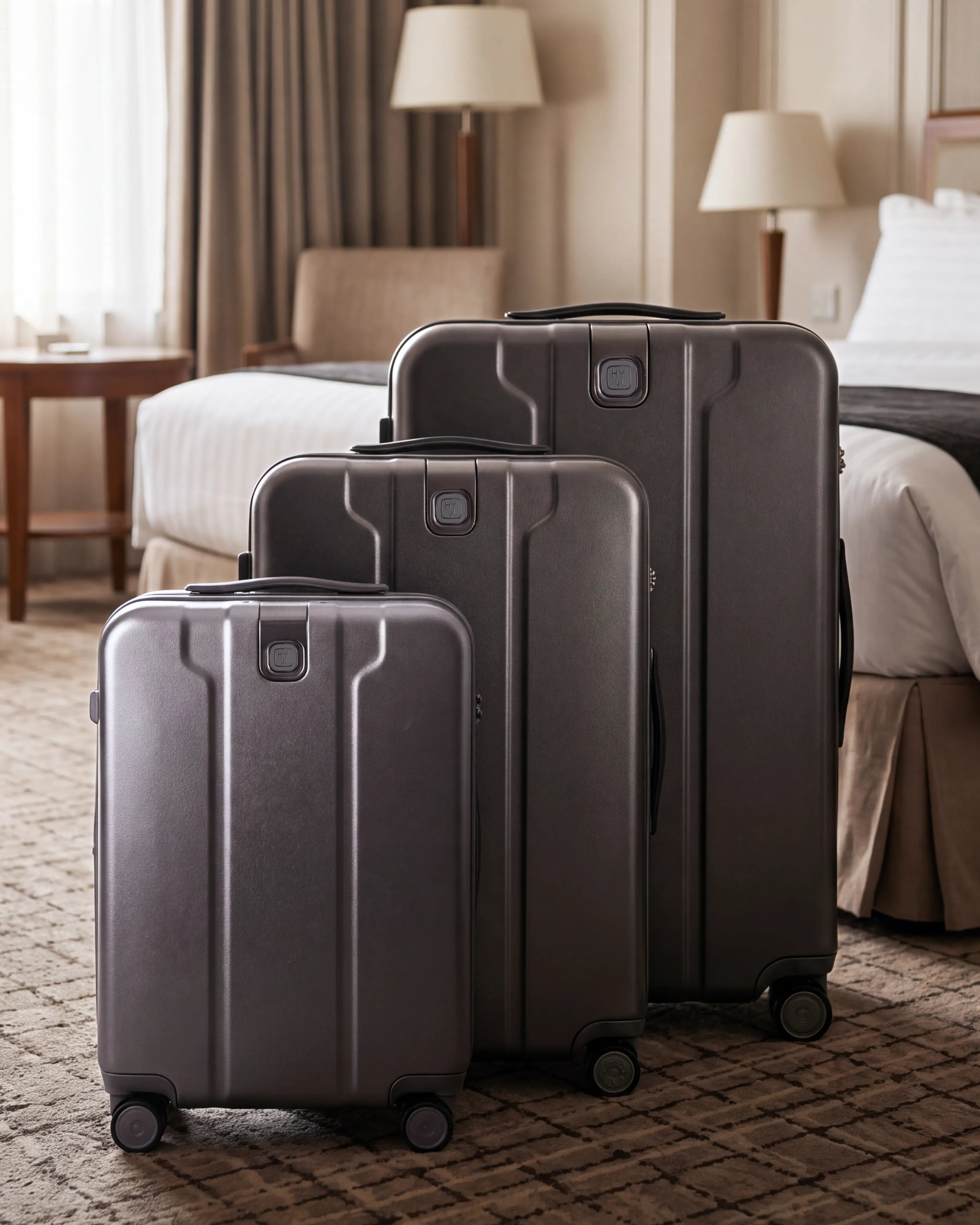
Durability Starts With Design
A durable suitcase is not defined by a single feature. Shell materials, wheel systems, handles, reinforcements, zippers, and attachment points all contribute to long-term performance.
A luggage system is only as strong as its weakest component. In practice, most suitcases fail in one of four places:
- Wheel housings. Every bump travels up through the wheel into the shell.
- Telescopic handle. Pulled, pushed and twisted on every trip.
- Carry handles. They take the full load each time the case leaves the ground.
- Corners. The first thing to hit the floor, the belt and the bin.
Material Matters, But It’s Only One Piece
Polycarbonate is the most common choice for durable hardshell luggage, and for good reason:
Polycarbonate flexes under impact and springs back where stiffer plastics crack. But grades vary between suppliers, and “polycarbonate” on a label can mean a blend. HYVL, for example, uses Makrolon® polycarbonate by Covestro so the shell material is the same specification in every case.
Even the best shell can’t make up for weak wheels, handles or attachment points.
| Shell material | Under impact | Trade-off |
|---|---|---|
| 100% polycarbonate | Flexes and recovers | Light and tough; grade varies by supplier |
| PC/ABS blend | Partly flexes | Cheaper; less resilient than pure PC |
| ABS | Stiff, more likely to crack | Lowest cost; weaker in the cold |
| Aluminum | Dents rather than cracks | Very strong; heaviest and shows every mark |
Wheels Often Determine Lifespan
Many luggage failures begin at the wheels. A complete wheel system is more than the wheel itself:
- Wheel size. Larger wheels roll more easily over seams, curbs and uneven ground, and spread the load of a heavier case.
- Bearings. They decide how smoothly the wheel turns and how long it keeps turning under load.
- Wheel housing. The part that passes every impact into the shell.
- Reinforcement. What keeps the housing attached after thousands of bumps.
Many brands use one wheel size on every suitcase because it is cheaper to make. HYVL sizes its Hinomoto silent-bearing wheels to the bag: 50 mm on the carry-on, 60 mm on the medium and large.
Reinforcements Are Often Overlooked
Most luggage marketing talks about shells and wheels. Far less is said about what holds them together, yet that is where many suitcases fail. Three areas matter most:
- Wheel mounting areas. Where wheel impact enters the shell.
- Corner reinforcement. Where drops and belt impacts land first.
- Handle attachment zones. Where the full packed weight hangs from the shell.
The aim is a clean load path, so impact spreads through the structure instead of building up at one point.
HYVL designs its reinforcements around the weight distribution of a fully packed suitcase and tests them from every direction, not just side to side. That is why its internal reinforcement has side ribs.
Handles Experience Constant Stress
A suitcase has three handle systems, and each takes load differently:
- Carry handle. Repeated acceleration, deceleration and sudden loading every time the case is lifted.
- Side handle. A different load path from the top, which needs its own testing.
- Telescopic handle. One of the most mechanically active parts: every extension, pull and change of direction loads it.
The Attachment Matters More Than the Handle
Handles rarely snap in the middle. They fail where they meet the shell. That is why handle testing should load the whole assembly, handle and connection points together.
HYVL tests each handle with a jerk test under a full internal load (44 lb carry-on, 55 lb medium and large): 3,000 cycles on the top handle, 3,000 on the side handle from the lateral position, and 500 on the telescopic trolley. The grip itself is genuine leather wrapped around a synthetic rubber core, so it doesn’t turn sticky like bare rubber.
Durability Must Be Proven Through Testing
“Tested to the highest standards” means little without numbers. Useful testing repeats real abuse under a realistic load and publishes the conditions.
Every HYVL test runs with an internal load of 44 lb for carry-on and 55 lb for medium and large.
Signs of Durable Luggage
Use these seven checks on any suitcase, whichever brand you’re considering. If a brand can’t answer one of them, that tells you something too.
- Polycarbonate shell100% polycarbonate flexes under impact and springs back. Ask whether it is a blend, and whether the resin is named.
- Reinforced wheel housingsWheels pass every bump into the shell. The mounting area needs to be built for that.
- Quality bearingsBearings decide how smoothly a wheel rolls and how long it keeps rolling under load.
- Durable zippersAn overpacked case strains the zipper constantly. A named maker such as YKK is easier to trust.
- Tested handle systemsHandles and their attachment points should be load-tested, top, side and telescopic.
- Long warranty coverageRead the exclusions. Many lifetime warranties cover defects only and leave out airline damage.
- Published testing standardsReal numbers and conditions beat “tested to the highest standards”.
Built for the Miles Ahead.
Durability isn’t one feature. It’s every part that takes a hit, chosen, reinforced and tested so a suitcase keeps working trip after trip.
Explore HYVL Luggage →
What makes luggage durable?
Durability comes from how the whole suitcase works together under load, impact and repeated use: the shell, wheel system, handles, reinforcements, zippers and attachment points. A suitcase is only as strong as its weakest component, which is why published testing matters.
What material is most durable for luggage?
Polycarbonate is widely regarded as one of the most durable materials for hardshell luggage due to its balance of impact resistance, flexibility, and low weight.
Are bigger luggage wheels better?
Larger wheels generally roll more smoothly, especially over uneven surfaces, when paired with a properly engineered wheel system.
What part of a suitcase breaks most often?
Common failure points include wheels, handle mechanisms, zippers, and attachment points subjected to repeated stress.
How is luggage durability tested?
Good testing repeats real abuse under a realistic load: handle jerk tests, trolley cycles, tumble tests and continuous wheel runs. HYVL tests with an internal load of 44 lb for carry-on and 55 lb for medium and large, including 3,000 top- and side-handle cycles, 500 trolley cycles, 50 tumble cycles after −12°C conditioning, and a 24-mile mileage test.
Do lifetime luggage warranties cover airline damage?
Often not. Many lifetime warranties cover manufacturing defects only and exclude airline or transit damage, so read the exclusions before you buy.
How long should quality luggage last?
The lifespan varies based on travel frequency, usage conditions, maintenance, materials, and construction quality.


